

Tina Engstrom

Cornelia Parker’s One More Time Unveiled at St Pancras

Cornelia Parker’s One More Time was unveiled recently at St Pancras International station as the inaugural artwork in Terrace Wires, billed as “the fourth leg” of London’s rotational public art spaces alongside the Fourth Plinth, Serpentine Gallery and the Tate Modern’s Turbine Hall.

The piece, which is a working replica of the station’s iconic DENT London clock reversed out in black with white hands and numerals and silver detail, is suspended 16 metres in front of the original so for those alighting from the trains the original face will gradually appear eclipsed. Conceived to invoke meditative thoughts on the passage of time, life and mortality Parker describes the clock as “the most conscious focus of a railway station, a dominant force”.
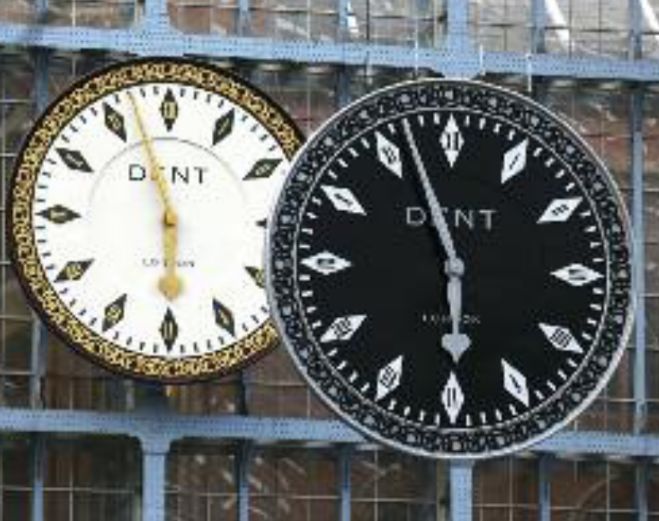
Cornelia Parker - One More Time

One More Time, 2015, by Royal Academician Cornelia Parker for Terrace Wires at St Pancras International station, co-presented by HS1 Ltd. and the Royal Academy of Arts. Photo: © Tim Whitby, Getty Images.



Leave a Reply

Your email address will not be published. Required fields are marked *

You may also like

Because I’m A Londoner: From Postman To Blue Badge Tourist Guide

This is part of a series of articles written by London Blue Badge Guides who used to be key workers in our capital city. First up is Neil Parker, who worked for 30 years as a postman before becoming a tourist guide. I qualified as a London Blue Badge Guide in 2013 and now, as my mates from the post would say, ‘I’m paid to be me!’ At least I was until March 2020 when Covid-19 arrived. This got me thinking, what was life like for my mates in the post? So, after it reopened, I went to the pub to find out.

Read more

Halloween History: Attitudes to Sorcerers and Witches in the Elizabethan and Stuart Courts

To put it mildly, attitudes towards witches and sorcerers in the Elizabethan period were confusing and often contradictory. While Bloody Mary (reigned 1553 - 1558) was vicious in her treatment of witches, Elizabeth I (1558 - 1603) had a more ambivalent relationship to this subject. After all her mother, Anne Boleyn had been accused of being a witch because of a malformation of her left hand, which appeared in the form of an extra finger. Elizabeth, as a strong female ruler, may not have been happy about hunting down the fair sex, therefore, and accusing those who might be innocent of any crime.

Read more